

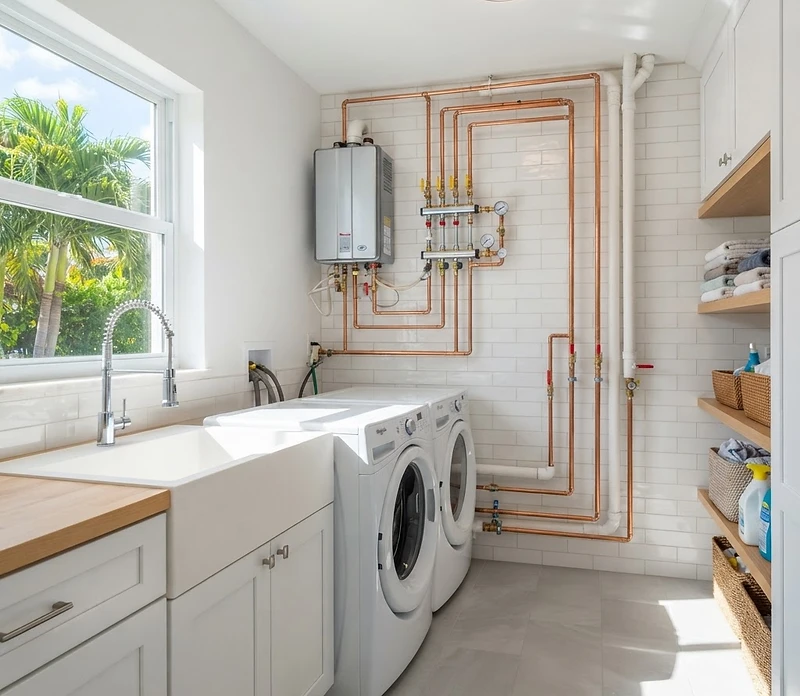
Plumbing
Plumbing Contractors in Florida
Repiping, water heaters, slab leaks and sewer lines across Miami-Dade, Broward and Palm Beach counties — where the housing stock is as much a factor as the water.
Find a Plumbing ContractorPlumbing in Florida
Plumbing Contractors in Florida
Plumbing problems in Florida tend to be age-driven. A large share of the region's housing was built in the decades when certain piping materials were standard, and those materials are now reaching or passing the end of their service life. Homeowners often discover this during a remodel, an inspection or a claim.
The second factor is the ground. Slab-on-grade construction is common throughout Miami-Dade, Broward and Palm Beach counties, which means supply and drain lines often run under the floor. A leak there is diagnosed differently and repaired differently than one in a wall or a crawlspace.
Plumbing is licensed and permitted work in Florida. Water heater replacement and repiping are permitted in most jurisdictions and should be inspected, and the licensed plumbing contractor is the person who holds responsibility for the work meeting code.
LVC is not a plumbing contractor. We help you understand what the work involves and what to verify, then connect you with a locally vetted plumbing professional whose experience fits the problem.
How it works
Repiping: when it becomes the right answer
Repiping replaces the home's supply or drain lines rather than repairing one section. It becomes the practical choice when failures are recurring, when the material itself has a known failure history, or when an inspection shows widespread deterioration.
Recognizing the material is the first step. Some pipe materials used in mid-to-late twentieth century Florida construction are widely understood to have elevated failure rates, and their presence — not just a single leak — is what drives the repiping conversation.
A whole-home repipe is disruptive: walls and sometimes floors are opened to route new lines. Because of that, the scope should state explicitly what happens afterward — patching, texture, paint, fixture reconnection and cleanup — and who performs each step.
Good to know
Water heaters and permits
Water heater replacement is one of the most common plumbing jobs in the region, and also one of the most commonly done without a permit. A permit matters here because installation involves temperature and pressure relief, venting or expansion control, and secure connections — the parts that prevent a failure from becoming property damage.
The choice between tank and tankless is partly a capacity question and partly an electrical or gas question. A tankless unit may require an upgraded circuit or gas supply, which is a separate licensed scope that should be identified before installation day.
Ask about the drain pan, the pan drain line and the shutoff valve while the unit is being replaced. Those inexpensive items are what keep a future leak contained.
Good to know
Slab leaks and sewer lines
A slab leak is a supply or drain line failure beneath the foundation. Symptoms include unexplained increases in the water bill, warm spots on the floor, the sound of running water when nothing is on, and persistent dampness or cracking.
Diagnosis should be documented, not guessed. Ask how the leak was located and for the evidence — pressure testing, acoustic detection or camera inspection — before agreeing to any approach that involves opening the floor.
Sewer and drain lines have their own diagnostic tool: a camera inspection. For older homes, the recording of that inspection is worth keeping, because it is the only way to see the actual condition of the pipe rather than inferring it from symptoms.
Before you hire
What to Verify on Every Plumbing Contractor
These checks take an afternoon and prevent most of the problems homeowners run into.
A licensed plumbing contractor
Florida licenses plumbing work specifically. Confirm the license number is current, matches the contract, and covers the scope being proposed — repiping, gas work and drain work are not interchangeable.
Permits for water heaters and repiping
Both are permitted work in most Florida jurisdictions and should close with an inspection. Confirm who is pulling the permit and ask for the closed permit record when the job is complete.
A scope that includes restoring what was opened
For repiping and slab work, the contract should state who patches walls and floors, who textures and paints, and who reconnects fixtures. Without it, restoration becomes a separate negotiation after the plumbing is done.
Evidence for the diagnosis
Ask to see the leak detection results or camera footage. That record supports the recommended repair, and it is also what you will want if the issue recurs or is later claimed.
Questions
Plumbing Questions Homeowners Ask
How do I know if my home needs repiping?
The signs are recurring leaks, low or discolored water pressure at multiple fixtures, visible corrosion or pitting at exposed sections, and the presence of pipe materials with a known failure history. Because much of the piping is concealed, the reliable answer comes from an inspection by a licensed plumbing contractor rather than from a single symptom.
Do I need a permit to replace a water heater?
In most Florida jurisdictions, yes. The permit covers the safety-critical parts of the installation — relief valve, venting or expansion control and connections — and it protects you if a failure later damages the home. Confirm the requirement with your local building department.
What is a slab leak and how is it fixed?
A slab leak is a leaking line beneath a slab foundation, common in this region's slab-on-grade homes. Diagnosis uses pressure testing or acoustic detection, sometimes with camera inspection for drains. Repair ranges from rerouting the line to opening the floor, so ask for the documented diagnosis before deciding which approach applies.
How can I reduce the chance of a plumbing emergency?
Know where your main shutoff is and confirm it actually turns off. Replace aging washing machine supply hoses, which fail quietly and often. Have the water heater serviced or replaced on schedule, and pay attention to changes in your water bill — a rising bill with no change in use is one of the earliest signs of a hidden leak.
Get matched
Find a Locally Vetted Plumbing Contractor
Tell us what you need done and we'll help you take the next step.
Related
All Trades & Contractors
